ABOUT THE ARTIST
CREATING ART MASKS AND EGG ARTISTRY
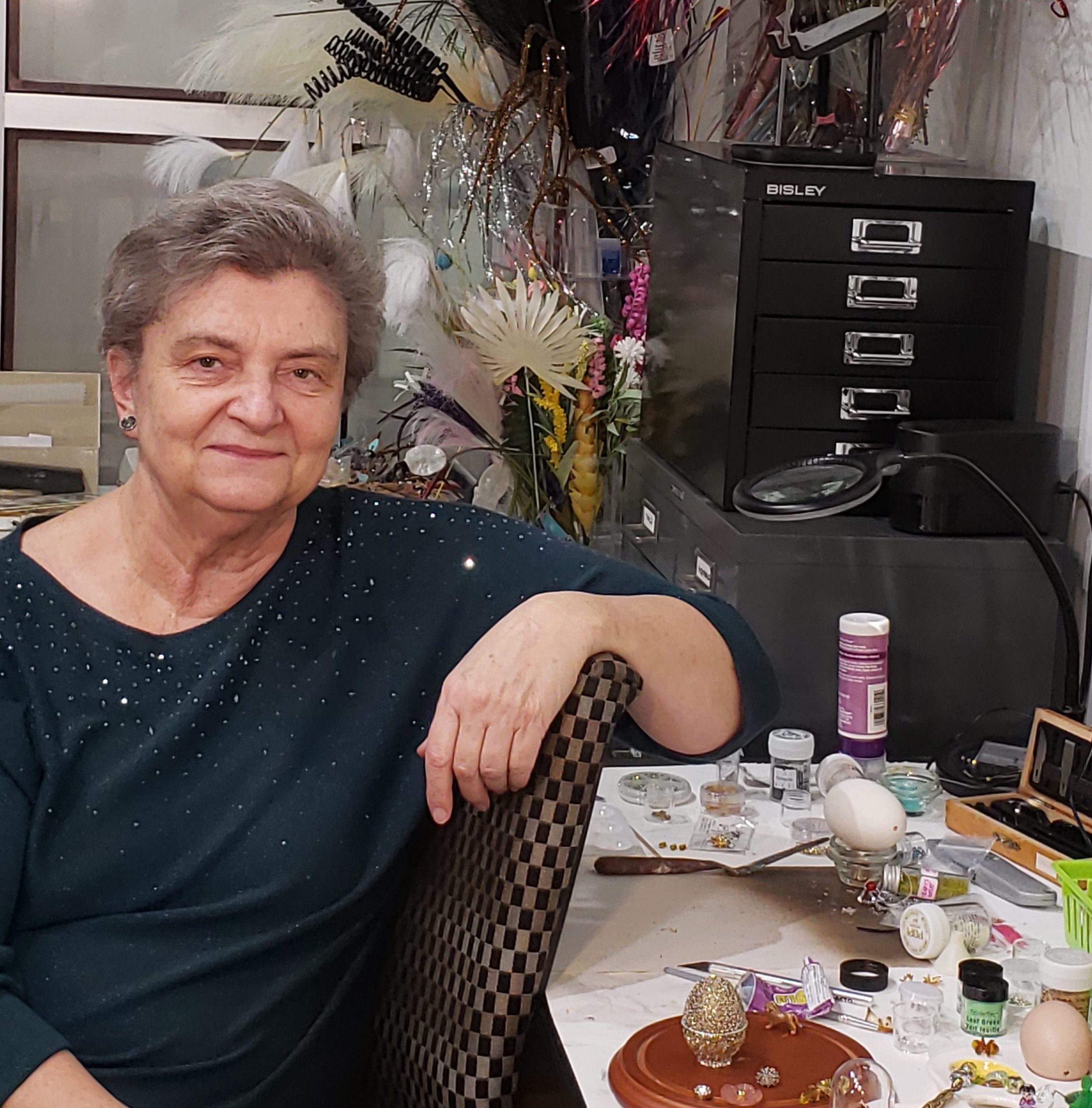
The sculptures as masks and fantasy “Pisanki” or “Pysanky” (egg artistry) in The Hawicz Collection are created by Basia Haszlakiewicz (AKA: Hawicz), artist in Houston, Texas. Basia earned a Bachelor of Arts from The University of Kansas, majoring in Interior Design and Theater Design. She practiced the craft of stage and costume design periodically during her formal career in architecture, focusing on masks as her preferred choice of artistic expression, seeing in them a canvas as varied as the people we meet on a daily basis.
The masks are designed to be displayed on the wall using a cusotmized wall bracket, on a mannequin, on a museum stand, or in an acrylic case (See “Instructions”). Many can also be worn on that special occasion. Make an impression at masquerades, Mardi Gras, Carnivale, costumed events, masked balls, or cosplay with this original and unique art.
“Pisanki” or “Pysanky” are decorated Easter eggs, in the tradition of the Slavic folk art. Painting and decorating Easter eggs was a favorite past time of the season. Handed down through generations, some of the oldest forms of this practice include blown white eggs soaked in onion skin, beets, spinach or other color releasing vegetables and inscribing designs and patterns onto the surface when dried. Basia has taken this craft to new dimension and infused them with stories and fantasies on a small scale.
The compositions are primarily a product of objects and materials, accumulated over many decades including a variety of embellishments, toys, nail art, seashells, stones, jewels, hardware, and just an unusual combination of everyday “stuff”. The hunt continues for compelling, properly scaled materials.
Each work starts with a palette of materials that evolves and unfolds. Some compositions manifest quickly, within a few days. Others might form over many weeks. Some even go into retirement and reemerge at a later time. Each is studied for scale, theme, compatibility of materials, color and durability. The palettes are kept on trays that allow the artist to compose and modify with ease. Compositions undergo numerous mock-ups and tests before being applied to the mask form. The artist’s studio is a cornucopia of tools, adhesives, and finds. In most cases the eggs are natural in origin: chick, duck, goose, ostrich. Occasionally, where an egg is heavy with structure or material, a wooden egg is used.
Some masks are “portraits”, inspired by friends or familiar characters. These are named in advance, like “Shoebecca", “Carmen” and “Pantera”. Other masks are the product of an interaction of materials and colors and find their names after completion.
Hawicz is an abbreviation of Haszlakiewicz and is used as AKA and DBA by members of the family. As with many immigrants, the artist's father felt it necessary to alter the name in order to be approachable. For his business practice, he abbreviated Haszlakiewicz to Hawicz to facilitate his professional identity. Now the artist has reclaimed the name to channel expression rather than conformity.
ARTIST’S STATEMENT: “Traditions Transformed” and “Iconeggraphy”
Creation is evolution. There is no vacuum. Everything we perceive is part of an ongoing journey, a dynamic interconnection where nothing exists in isolation. To be inventive is to perceive the familiar through a fresh lens, pushing boundaries and reshaping the narrative.
My work begins with the quiet simplicity of an egg—a form both ancient and universal. Across cultures, it has carried stories, symbols, and traditions. Inspired by the Slavic art of Pisanki and shaped by my architectural background, I approach the egg not only as a surface, but as a small world waiting to be built.
I build upon its shell, introducing depth, structure, and intimate scenes that transform the egg into a vessel for narrative. Texture, space, and color come together to create environments where characters and emotions emerge in miniature. Each piece becomes its own universe—part folklore, part sculpture—inviting viewers to look closely and discover the stories held within. Often the work begins with a cultural symbol or icon that serves to inspire the story.
Masks are magical. Through this craft, I am able to personify unique individuals and personalities. With each composition, I contemplate shape, expression and emotion and rearrange materials until a cohesive personality emerges. I often study masks of indigenous and pop culture to learn the art of facial expression and costumery as part of my design process.
I am driven to explore, manipulate and advance the visuals in my experience.
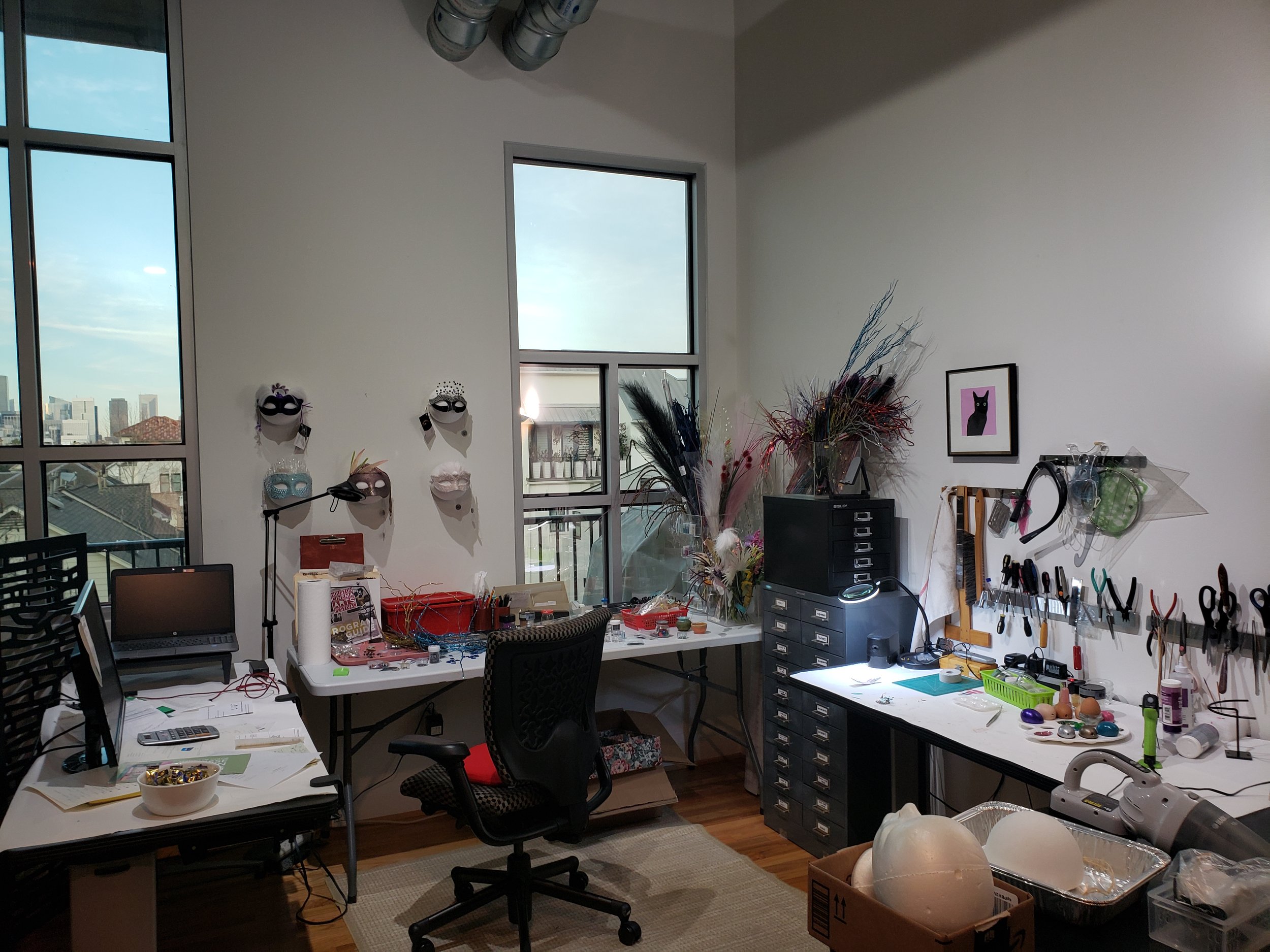
Artist's studio

The artist at work

Composition in progress

Artist's tools

Under construction

Color study

Compositions in progress

Tool bar